> For the complete documentation index, see [llms.txt](https://docs.appstrategy.com/apprules-r-documentation/llms.txt). Markdown versions of documentation pages are available by appending `.md` to page URLs; this page is available as [Markdown](https://docs.appstrategy.com/apprules-r-documentation/platform/platform-features/sourced-values/overview.md).

# Overview

## Sourced Values Overview

To deliver a code-free environment where projects can be created and deployed quickly, appRules employs “Sourced Values”.  In simple terms, a Sourced Value allows you to quickly select a source for a value and an identifier for it.   To specify a sourced value, you select the Source and then specify a value identifier (Source Value Identifier).  Below are some examples of the many sourced values used in appRules:

<table><thead><tr><th width="223">Source</th><th>Value Identifier</th></tr></thead><tbody><tr><td>String</td><td><p>The String source allows you to enter any value in the value identifier.    </p><p>Example:  </p><p><strong>String:John Smith</strong></p></td></tr><tr><td>DataFieldValue</td><td><p>The DataFieldValue source gets a value from a record that exists in a specific Source or Target in the project.   </p><p>Example: </p><p><strong>DataFieldValue:Employees.LastName</strong></p><p>Gets the value of the LastName column in the Employees record.</p></td></tr><tr><td>DateTime</td><td><p>The DateTime sourced value points to a date/time related value.  They can also be used to specify other date/time related data.   Example: </p><p><strong>DateTime:DateTimeNow</strong></p><p>Generates the current date/time.</p></td></tr><tr><td>ActionField</td><td>The ActionField source allows you to select an action that you have defined using the Action Editor to get a value.</td></tr></tbody></table>

The above examples give you an idea of how Sourced Values are defined and used in appRules.  They can be used to get and set data anywhere in your projects.

By providing a rich set of editors to manage Sourced Values, appRules is able to provide a very powerful and flexible combination that gives users the fastest and most compact environment for configuring workflow activities, actions, conditions, and orchestrating processes.

## Sourced Values Examples

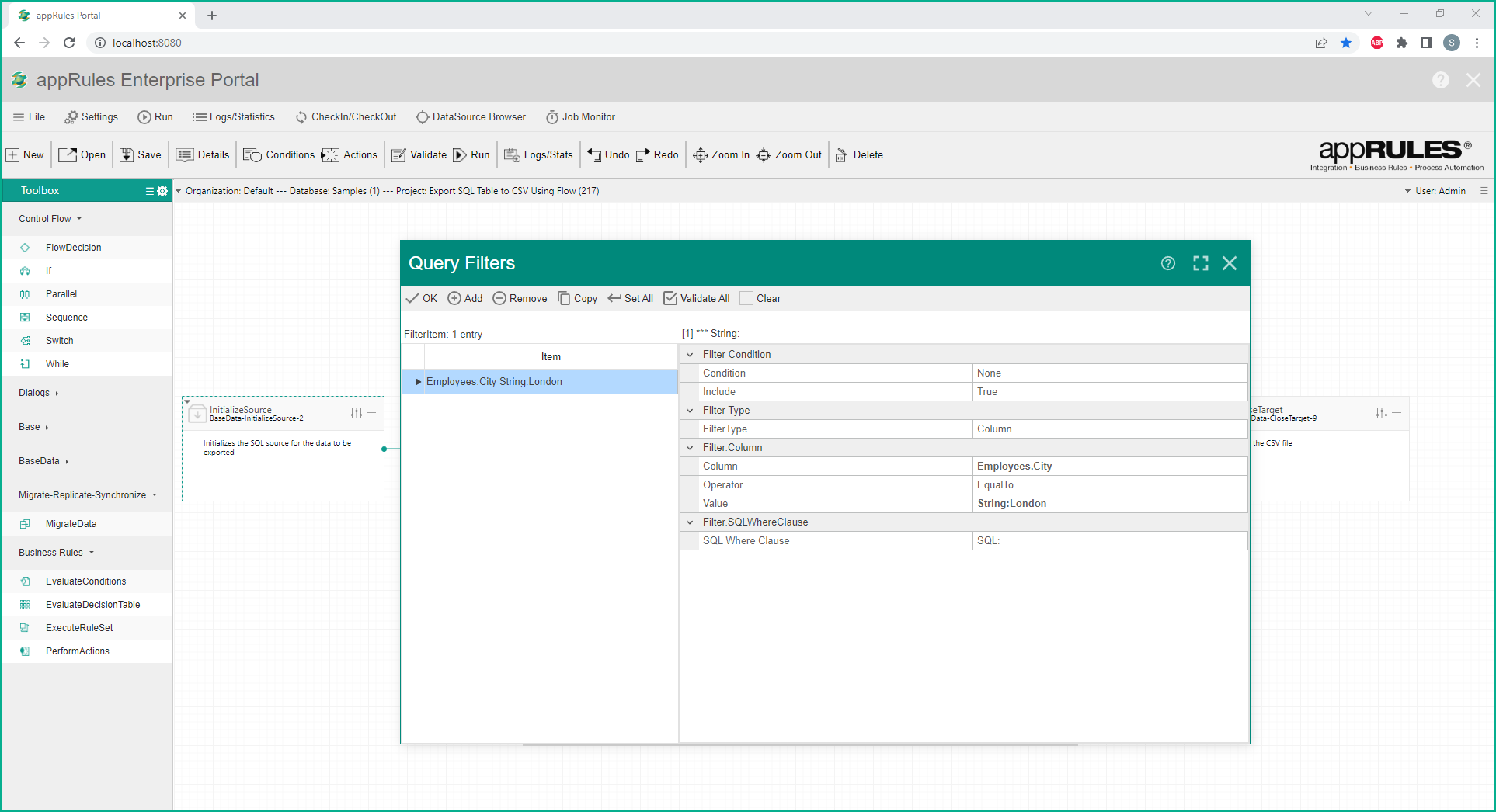
### Sourced Values in Query Configuration

Below is an example of Sourced Values used for configuring a query:

<figure><img src="/files/T6vJeuucg1fqotiYezJv" alt=""><figcaption></figcaption></figure>

### **Sourced Values in Mapping**

The example below shows Sourced Values in use for mapping.

<figure><img src="/files/JkY9tNrdVlVa4QXrI636" alt=""><figcaption></figcaption></figure>


---

# Agent Instructions
This documentation is published with GitBook. GitBook is the documentation platform designed so that both humans and AI agents can read, navigate, and reason over technical content effectively. Learn more at gitbook.com.

## Querying This Documentation
If you need additional information that is not directly available in this page, you can query the documentation dynamically by asking a question.

Perform an HTTP GET request on the current page URL with the `ask` query parameter, and the optional `goal` query parameter:

```
GET https://docs.appstrategy.com/apprules-r-documentation/platform/platform-features/sourced-values/overview.md?ask=<question>&goal=<endgoal>
```

`ask` is the immediate question: it should be specific, self-contained, and written in natural language.
`goal` is optional and describes the broader end goal you are ultimately trying to accomplish on behalf of the user. GitBook uses it to tailor the answer towards what is most useful for that goal.

The response will contain a direct answer to the question and relevant excerpts and sources from the documentation.

Use this mechanism when the answer is not explicitly present in the current page, you need clarification or additional context, or you want to retrieve related documentation sections.
